What It Actually Takes to Start a Podcast for Your Organization
Launching a podcast for your institute, nonprofit, or company? Here's what actually matters: format, gear, workflow, and a 90-day pilot plan. And it's not the microphone.
Every few weeks, someone launching something new, an institute, a practice, a nonprofit, asks me the same question.
"What will it take to start a basic podcast to support our work?"
I've answered it enough times, across 750+ episodes of my own show and dozens of studio consults, that I decided to write it down once and answer it properly.
Here's the honest answer. It's shorter than you think, and it's not about the microphone.
Start with the job, not the show
Before gear, before format, before a name, answer one question: what is this podcast's job?
For an organization, it's usually one of three things.
Authority. You're proving you know your field by demonstrating it in public, episode after episode. Not claiming expertise, showing it.
Community. You're giving the people you serve a reason to gather around your ideas. The podcast becomes the campfire.
Pipeline. You're starting conversations that turn into clients, partners, donors, and members. Every episode is a door someone can walk through.
Pick one as primary. You'll get the other two as side effects, but a podcast trying to do all three at once does none of them well.
I've watched organizations skip this step and launch a show that was technically fine and strategically pointless. Six months in, nobody could say what it was for, so nobody could say whether it was working. And a show nobody can evaluate is a show that quietly dies.
The show is the vehicle. The job is the destination.
The format decision matters more than the equipment decision
Most new organizational podcasts overthink gear and underthink format. It should be the other way around.
Three formats work reliably for a new organization:
Co-hosted conversation. Two founders talking through the ideas the organization is built on. This is the lowest lift: no guest scheduling, no cold outreach, just the two of you and a calendar invite. It also builds both voices at once, which matters when the organization is the sum of its founders. The risk: it can drift into inside baseball. You fix that by anchoring every episode to a question your audience is actually asking.
Interview show. You bring in guests from your field: practitioners, researchers, people doing the work. It's more scheduling effort, but here's what most people miss: every guest becomes a relationship, and every relationship becomes reach. When your guest shares the episode with their network, your organization gets introduced by a trusted voice. This is the format that built my entire ecosystem. Hacks & Hobbies started as a way to document a hobby; the conversations became the business.
Short solo briefings. Ten to fifteen minutes, one idea per episode, one host. This works especially well in fields like governance, policy, or compliance, anywhere your audience needs frameworks explained clearly and doesn't have an hour to spare. It's also the easiest format to produce consistently, because there's no coordination at all.
There's a fourth option almost nobody considers: start with one, plan for another. Launch as a co-hosted conversation for the first season while you build your guest list, then evolve into interviews in season two. Your format can grow with your organization.
You don't have to choose forever. But choose for the first season.
What to name it, and what to skip
A quick word on branding, because organizations tend to burn weeks here.
Name the show something a stranger can understand without explanation. If your institute focuses on governance, the word governance should probably be in or near the title. Clever names win awards; clear names win subscribers.
Skip the custom theme music, the animated intro, and the logo debates, for now. A clean cover image with readable text at thumbnail size is the whole requirement. You can invest in the identity once the show has proven itself.
Weeks spent on branding are weeks not spent publishing. Publishing is what builds the brand.
The gear conversation is shorter than you expect
I've spent 25+ years in video and AV, and here's what I tell every organization starting out: your first setup should be boring.
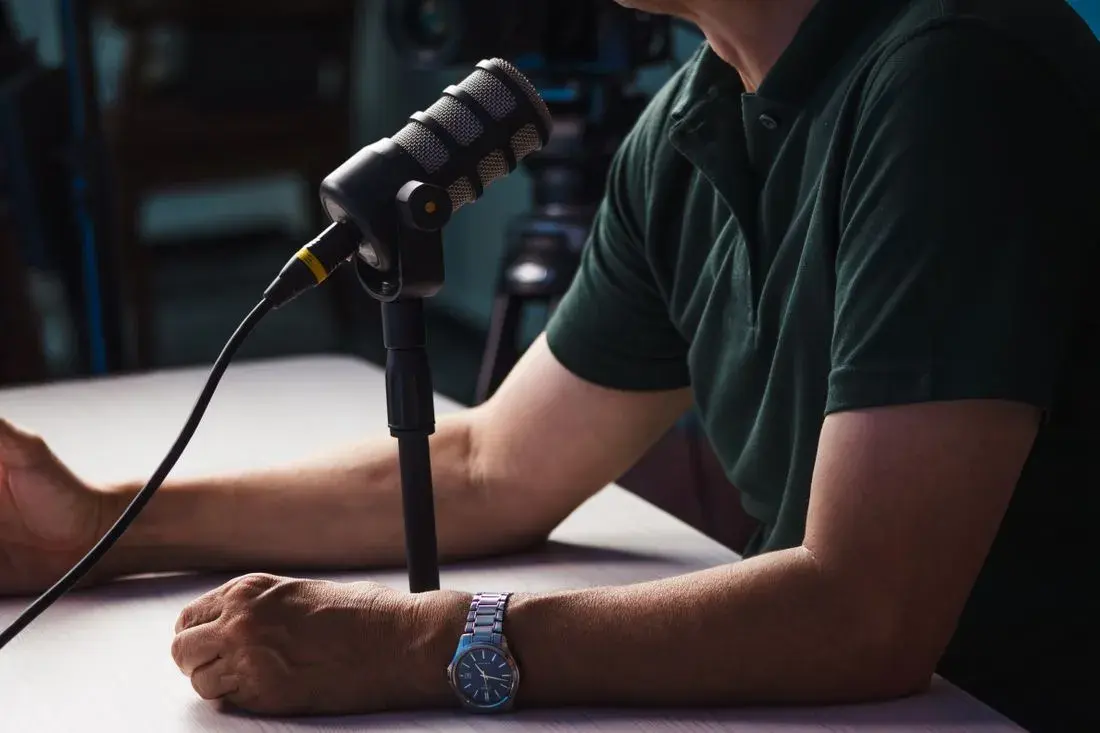
For audio: a solid microphone per host, one designed for spoken voice, positioned close to your mouth. A quiet room with soft surfaces; a home office with bookshelves and curtains beats an empty glass conference room every single time. Hard rooms create echo that no editing can fully remove. Soft rooms are free.
For remote recording: software that captures each person locally, on separate tracks. This one decision saves more headaches than any piece of hardware. Separate tracks mean one person's barking dog doesn't ruin the other person's audio, and internet hiccups don't degrade the recording.
For video (and for a new institute building visibility, I'd recommend it), a camera you already own is enough. Your phone on a small tripod at eye level produces better results than an expensive camera positioned badly. Face a window or add one soft light. Clean up whatever's behind you. Done.
That's genuinely the whole list. Notice what's not on it: a mixer, a boom arm rig, acoustic panels, a dedicated room. Those are all fine things. None of them belong in month one.
I build full studios for clients: ceiling-mounted lighting, acoustic treatment, multi-camera setups, teleprompters. I love that work. And I will still tell you: the fancy studio is a year-two decision, earned by a year-one habit.
Clarity and consistency. Everything else is decoration.
The workflow is where podcasts live or die
Nobody quits podcasting because their microphone wasn't good enough. They quit because the workflow was heavier than they expected.
Here's a workflow an organization of two can actually sustain:
Batch your recordings. Two or three episodes in one sitting. The setup cost, mentally and physically, is the same for one episode as for three. Batching means one recording day covers a month of publishing.
Keep editing light. A conversation-driven show needs cleanup, not cinema. Remove the long pauses, the false starts, the "let me say that again" moments. Resist the urge to polish every breath. Your audience came for the ideas.
Write the episode notes the same day you record. While the conversation is fresh, capture the three main takeaways, the guest's links, and one quotable moment. Do it a week later and it takes three times as long.
Assign one owner for publishing. Even if hosting is shared, publishing can't be. Someone owns the checklist: audio uploaded, notes posted, episode shared. Shared ownership of publishing is how episodes sit unpublished for two weeks.
And then there's the part almost everyone skips: what happens after the episode goes live.
Guests who never hear from you again. Listeners who reached out once and got no reply. Conversations that could have become partnerships, collaborations, or funding, left sitting in a feed.
For an organization, this is the most expensive mistake available. You did the hard part. You had the conversation. The follow-up (a thank-you, a share, a "here's how our audiences overlap" note) costs minutes and returns relationships.
The episode is not the relationship. The follow-up is.
Launch it as a 90-day pilot
Here's the structure I recommend to every organization starting from zero, and it's the same one I've proposed to networks and institutes I advise.
Commit to a 90-day pilot. Roughly six to eight episodes, published biweekly. Biweekly is the honest cadence for a small team: frequent enough to build momentum, forgiving enough to survive a busy week.
Record three episodes before you launch anything. A banked buffer is the difference between a show and a scramble. When episode one goes live, episodes two and three are already done.
Announce it alongside your launch. If your organization is going public in the fall, time the podcast to arrive with it. The show and the organization introduce each other. Every announcement post gets a "and here's our podcast" line; every episode gets a "here's what we're building" mention.
At day 90, review honestly. Is it serving the job you gave it in step one? Is the workflow sustainable at your actual energy level, not your launch-week energy level? Did anything surprising happen, a guest relationship, an audience segment, an episode that outperformed? Then decide: continue, adjust, or stop.
A pilot removes the pressure of "we're podcasters now, forever." It gives you permission to learn in public and decide with real data instead of guesses. And if the answer at day 90 is "this isn't the right vehicle," that's a successful pilot too. You learned it in one quarter instead of three years.
Most shows that fail were never designed to be evaluated. Design yours to be.
What this costs, honestly
For a basic two-host organizational podcast:
A few hundred dollars in equipment you'll use for years. Modest monthly costs for remote recording and podcast hosting, comparable to a couple of software subscriptions you already carry. And the real investment: two to four hours per episode across recording, light editing, notes, and publishing.
That's the actual price of admission. Not the ten-thousand-dollar studio. The hours, held consistently.
If those hours don't exist on your team, that's not a dealbreaker, it's a design constraint. It means you choose the short solo format, or you bring in help for the editing and publishing so the founders only spend time where only founders can: in the conversation itself.
Know your constraint before you launch, and build the show that fits it.
Before your first recording, have answers to these
If you take nothing else from this piece, walk into your planning conversation with answers to five questions:
What is the podcast's one job? Who is the single listener it serves, not the demographic, the person? Which format fits your team's real capacity? What does the day-90 review need to show for this to continue? And who owns publishing?
Five answers. That's the entire strategy document. Everything else is execution.
I have this conversation with people every week: founders, institutes, nonprofits, all asking the same question in different words. The answer is never really about equipment. It's about designing a show your organization can actually sustain, pointed at a job it can actually do.
That's what Home Studio Mastery is for. If you're launching something and thinking about a podcast to support it, reach out, let's map your first season before you buy a single piece of gear.
- #podcast launch
- #organization podcast
- #thought leadership
- #home studio
- #90-day pilot
Ready to build the real thing?
When you're ready for a done-for-you studio, book a discovery call and we'll map a build that fits your space.